

The Fear of Sounding Stupid As Creativity Block
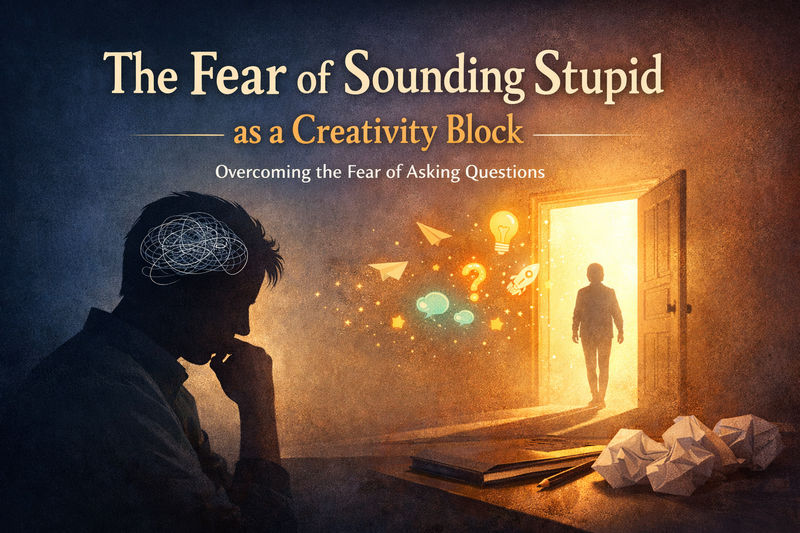
Creativity rarely disappears because we run out of ideas.
More often, it retreats because we become afraid of our own questions.
One of the most persistent blocks to creativity—especially in adults—is the fear of sounding unintelligent. It is subtle, socially reinforced, and deeply human. Over time, it convinces us that curiosity is risky, that questions expose weakness, and that silence is safer than exploration. Yet history, psychology, and innovation research all point to the same conclusion: fear shuts creativity down faster than failure ever could.
Curiosity Is Natural—Until It Is Corrected
Developmental psychologists have long observed that children are wired for curiosity. Jean Piaget, one of the founders of developmental psychology, described children as “little scientists,” constantly experimenting with the world through questions, trial, and error.
Children ask not because they lack knowledge, but because their minds are actively constructing it.
However, as children grow, curiosity is slowly filtered through social approval. Questions that interrupt, challenge authority, or appear obvious are discouraged. Over time, children learn to replace wonder with correctness.
Psychologist Lev Vygotsky emphasized that learning is a social process—but social environments also decide what kinds of thinking are acceptable. When questioning is subtly punished, curiosity becomes cautious. Creativity does not vanish; it becomes guarded.
The Decline of Questioning and Creative Confidence
Research consistently shows that questioning behavior declines sharply with age. While young children ask hundreds of questions a day, adults often ask very few—especially in group or professional settings.
Why?
Because questions are no longer neutral. They become signals.
Signals of competence. Signals of status. Signals of belonging.
Psychologist Carol Dweck, in her work on mindset, explains this shift clearly. In a fixed mindset, people avoid questions because they fear revealing inadequacy. In a growth mindset, questions are tools for learning rather than threats to identity.
She writes in Mindset:
“When people are focused on proving their intelligence, they stop doing the things that actually make them smarter.”
Creativity thrives in growth. Fear thrives in performance.
Why Adults Fear “Obvious” Questions
In adult life—especially in schools, workplaces, and professional environments—intelligence is often performed rather than practiced. Meetings reward fluency, confidence, and speed. Uncertainty is interpreted as weakness. Silence is mistaken for understanding.
This is where creativity quietly breaks.
Author and journalist Kathryn Schulz, in her book Being Wrong, argues that modern culture has an unhealthy relationship with error and uncertainty. We are taught not just to avoid being wrong, but to avoid appearing wrong.
She writes:
“To err is to wander and wandering is the way we discover the world and lost in thought it is the also the way we discover ourselves...”
The fear of sounding stupid is not about lack of intelligence. It is about social risk.
Innovation Thrives Where Questions Are Safe
Organizations that innovate consistently tend to share one critical trait: psychological safety.
Google’s well-known internal research project, Project Aristotle, studied hundreds of teams to determine what made them successful. The most important factor was not talent, experience, or confidence—it was whether team members felt safe asking questions, admitting confusion, and challenging assumptions.
Creativity followed safety.
Similarly, Pixar’s former president Ed Catmull explains in Creativity, Inc. that early ideas are almost always flawed—and that pretending otherwise destroys them.
“Early on, all of our movies suck. That’s the rule.”
At Pixar, questions are not interruptions. They are lifelines.
The Power of Beginner’s Eyes
Astrophysicist Neil deGrasse Tyson often speaks about the value of childlike curiosity. He argues that children do not need to be taught curiosity—they need to be protected from losing it.
In interviews, he has said:
“Children are born scientists. They experiment with the world around them. We beat it out of them.”
Seeing the world with beginner’s eyes allows us to notice what experts overlook. Familiarity creates blindness. Simplicity reveals structure.
When we stop asking basic questions, we stop seeing basic truths.
Asking Questions Is Not a Reputation Risk
Management theorist Peter Drucker once noted that organizations fail not because they ask the wrong questions, but because they stop asking altogether. Leaders who remain curious stay relevant. Those who protect their image eventually protect their ignorance.
In creative work—whether design, strategy, writing, or problem-solving—the questions asked at the beginning shape the quality of outcomes at the end.
Clients, audiences, and users never see the early questions.
They only experience the clarity of the final idea.
Curiosity is judged privately. Results are judged publicly.
Breaking the Block
The fear of sounding stupid is not a flaw. It is a learned reflex.
And like all reflexes, it can be unlearned.
The next time you hesitate before asking a question, pause and notice the feeling. That discomfort is not danger—it is expansion. Ask anyway. Ask gently. Ask honestly. Ask without decorating the question to sound clever.
Often, someone else is relieved you spoke first.
Creativity does not ask for brilliance at the door.
It asks for openness.
When questions are allowed to breathe, ideas follow naturally—sometimes quietly, sometimes wildly, always honestly.
Curiosity is not childish.
It is foundational.
And every time you choose wonder over appearance, you reclaim a piece of the creativity you were born with.